Best Raffle & Competition Software in the UK (2026): An Honest Comparison
Verified Draws · 4 July 2026
Search for "best raffle software UK" and you get a wall of listicles that all read the same: ten logos, a feature grid, a star rating, and a tidy conclusion that — surprise — favours whoever wrote the page. This is not that. It is an honest map of the actual UK competition-software landscape, sorted by the kind of tool each one really is, and scored on the axes that genuinely differ between them. We build one of these tools, and we will tell you plainly where it wins, where it does not, and when you should stay exactly where you are.
The five kinds of UK competition software
Almost everything sold as "raffle software" falls into one of five buckets. They are not really competitors with each other so much as different answers to different questions, and picking well starts with knowing which bucket you are shopping in.
- Hosted website builders — RaffleX-style. You get a branded competition website that goes live fast, with instant wins, ticketing and a builder — no code, no hosting to run. You are renting a purpose-built raffle site. Great for launching quickly; you are inside one vendor's feature set.
- Marketplaces — Raffall-style. You list your raffle on a shared marketplace that brings its own audience and handles ticket sales, the draw and payouts, typically for a commission on each sale. You trade a cut and less branding control for built-in traffic and compliance handling.
- Charity & fundraising tools — Zeffy, GalaBid, RallyUp and similar. Built for non-profits and events — donation-first, often with gift-aid and in-person auction features. Excellent for a charity gala; not designed for a commercial, high-volume competition business.
- DIY WooCommerce + a raffle plugin — WordPress, WooCommerce and a competitions plugin. Maximum control and ownership; you become the systems administrator. We wrote a full, honest breakdown of what that stack really costs in Raffle Website vs WordPress.
- Provably-fair hosted platforms — RaffleForge. A hosted, purpose-built platform where the storefront, dashboard, payments and — the part nobody else leads with — independently verifiable draws are all first-class. This is the bucket we are in, and the one we will be most honest about below.
The axes that actually differ
Feature grids are noisy because most tools do most things. These are the axes where the buckets genuinely diverge — the ones worth weighting when you choose:
- Time-to-launch — minutes for a hosted builder or marketplace, days-to-weeks for a self-built WooCommerce stack.
- Hosting and upkeep burden — who patches, backs up and scales the thing: the vendor, or you.
- Payments — whether checkout, card processing and payouts are built in or assembled from plugins and add-ons.
- Traffic-spike handling at competition close — the one moment your site is hammered, and the one an entry-level self-hosted plan handles worst.
- Independent verifiability of the draw — whether an entrant can check, for themselves, that the result was not steered. This is the axis almost every listicle omits entirely.
That last axis is the one we care about most, because it is the one the UK is now moving on. The Department for Culture, Media and Sport published its Voluntary Code of Good Practice for Prize Draw Operators on 21 November 2025, in effect from 20 May 2026, and it expects draw outcomes to be checkable by someone other than the operator. It covers a sector now worth roughly £1.3 billion a year across 7.4 million participants and more than 400 operators — so "can an entrant verify this?" is no longer a nice-to-have. We unpack the Code in UK Prize Draws Are Changing.
How the buckets score on verifiability
Here is the honest part most roundups skip. On features, payments and polish, the mature tools are all broadly capable. On whether an entrant can independently check the draw, they mostly land in the same place — and it is not a flattering one.
- Hosted builders & DIY WooCommerce — The winner is picked inside the operator's own system, with a random-number generator the operator controls. Honest or not, the entrant has only the operator's word and, at best, a screen recording — which is trivially re-shot until the right name appears.
- Marketplaces — Better on trust because a third party runs the draw and the audience is shared — but the entrant still cannot reproduce the result themselves. You are trusting the marketplace instead of the operator, not verifying anything.
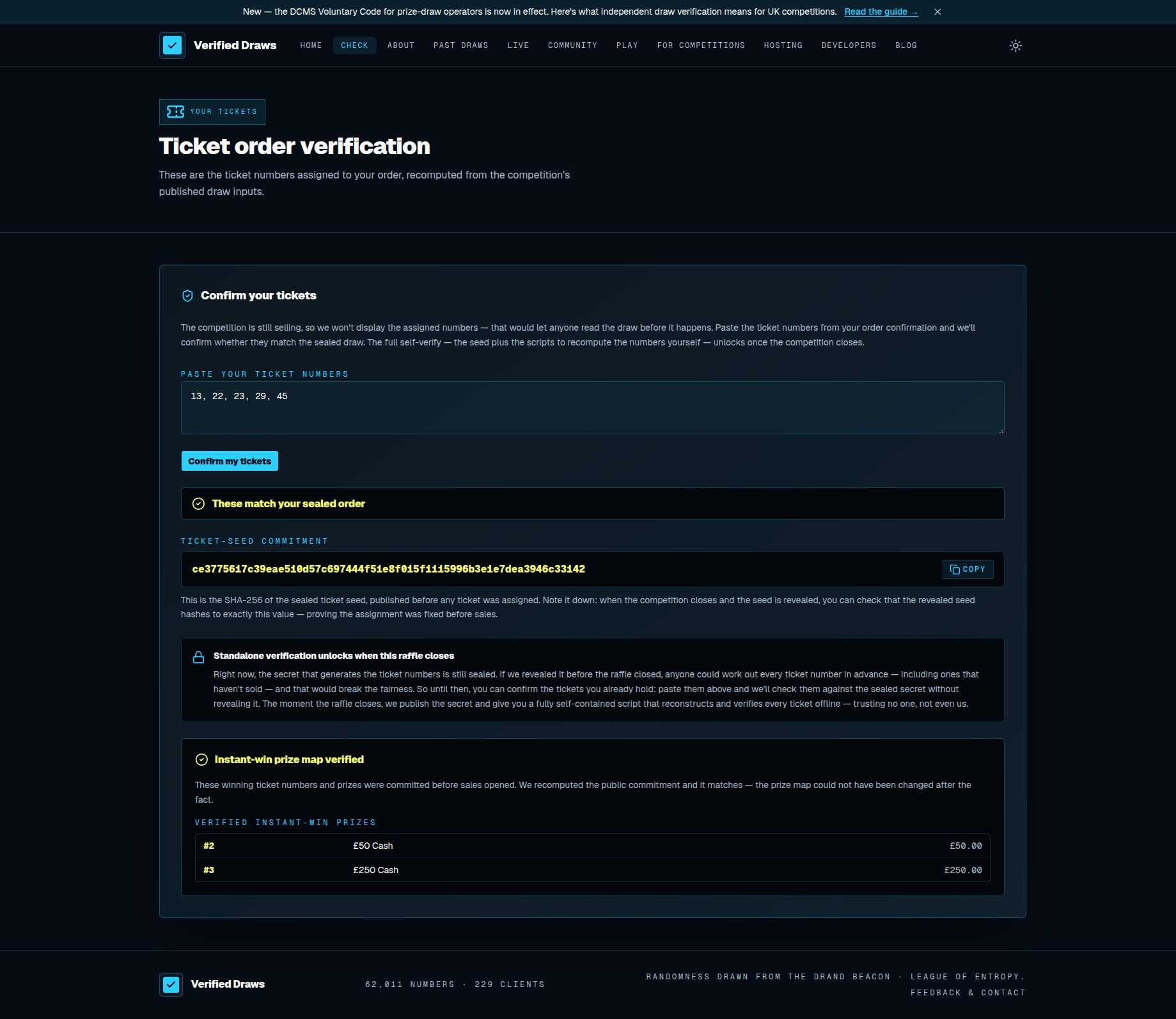
- Provably-fair platforms — RaffleForge commits every draw to a specific future round of drand, a public randomness beacon run by the independent League of Entropy. The random value does not exist when the draw is committed, so nobody can steer it. Every win — main-draw and instant alike — links to a verification page anyone can check.
Where RaffleForge fits — honestly
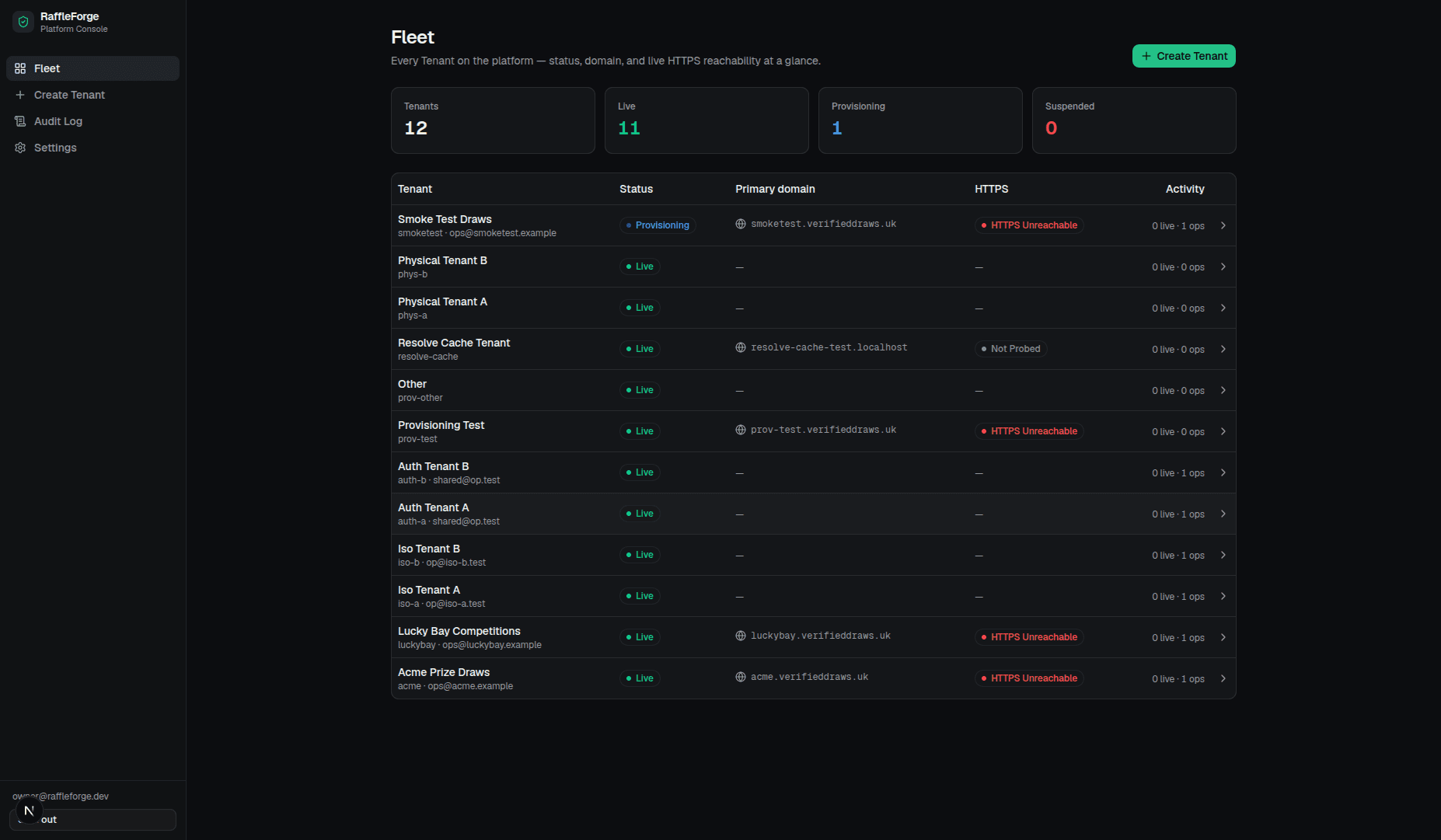
We are not going to tell you RaffleForge is the only right answer, because it is not. It is a hosted, purpose-built platform: you sign up and your branded storefront goes live on a secure subdomain (yourname.verifieddraws.uk) with HTTPS included, and you can graduate to a custom domain with the SSL handled for you. Underneath sits a raffle-specific dashboard — Competitions, Instant Wins, provably-fair Draws, Customers, Store Credits, Orders, Payments and Branding as first-class objects — with Stripe-powered checkout and true database-per-tenant isolation. And every draw is drand-committed and independently verifiable, which is the one axis we lead on that the rest of the field does not.
If you run a busy charity gala with in-person auctions, a fundraising tool may fit you better. If you want a shared marketplace to bring you an audience, that is a real advantage we do not offer. We would rather point you to the right bucket than win the wrong customer.
Already on another stack? Don't replatform — add the free layer
Here is the path most roundups will never tell you about, because it does not sell them a subscription. If you already have a working competition site — WooCommerce, a hosted builder, anything — you do not have to move to gain independent verifiability. The provable-fairness layer is free and portable. Add the Verified Draws WordPress plugin (or use the API): push a finished competition in one button, draw the winner live, and hand every entrant an independent verify link. You keep your stack and close the one gap it had.
That matters because replatforming an established store is genuinely risky — poorly-executed ecommerce migrations commonly lose 20-60% of organic traffic in the first 90 days. If you are already ranking and selling, the smart move is to add the fairness layer, not tear the site down.
So which is the best raffle software in the UK?
The honest answer is: it depends which bucket your business is in.
- Launching a competition business from scratch — A hosted platform saves you from becoming a part-time sysadmin. If independent verifiability matters to you — and under the DCMS Code it increasingly should — RaffleForge is built around it. Read the full hosting pitch.
- Want built-in audience over branding — A marketplace like Raffall trades a commission for traffic and compliance handling. A fair choice if reach is your bottleneck.
- Charity or one-off event — A fundraising-first tool with gift-aid and auction features will serve you better than any commercial competition platform.
- Already have a working store — Do not replatform. Keep your stack and add the free Verified Draws plugin for the verifiable-draw layer.
See both sides for yourself
The fastest way to judge any of this is to look, not to read a star rating. Watch a live competition and draw, verify a real result yourself — pull the same public random value, re-run the maths, land on the same winner — and read the deeper WordPress-vs-hosted breakdown. When you are ready to launch a provably-fair storefront, create yours here and it goes live on a secure subdomain in minutes.
One honest note, because we are a verification company and will not oversell. Provable fairness is a narrow, precise guarantee: that a published winner is the deterministic result of a public random value committed before the draw. It does not vet who entered, and it is not a substitute for following UK competition rules, publishing clear terms, or offering a genuine free entry route where one is required. It settles one question the rest of this market leaves open — whether the draw itself was straight — and hands your entrants the means to check.