UK Prize Draws Are Changing: Why Verifiable Randomness Matters
Verified Draws · 11 June 2026
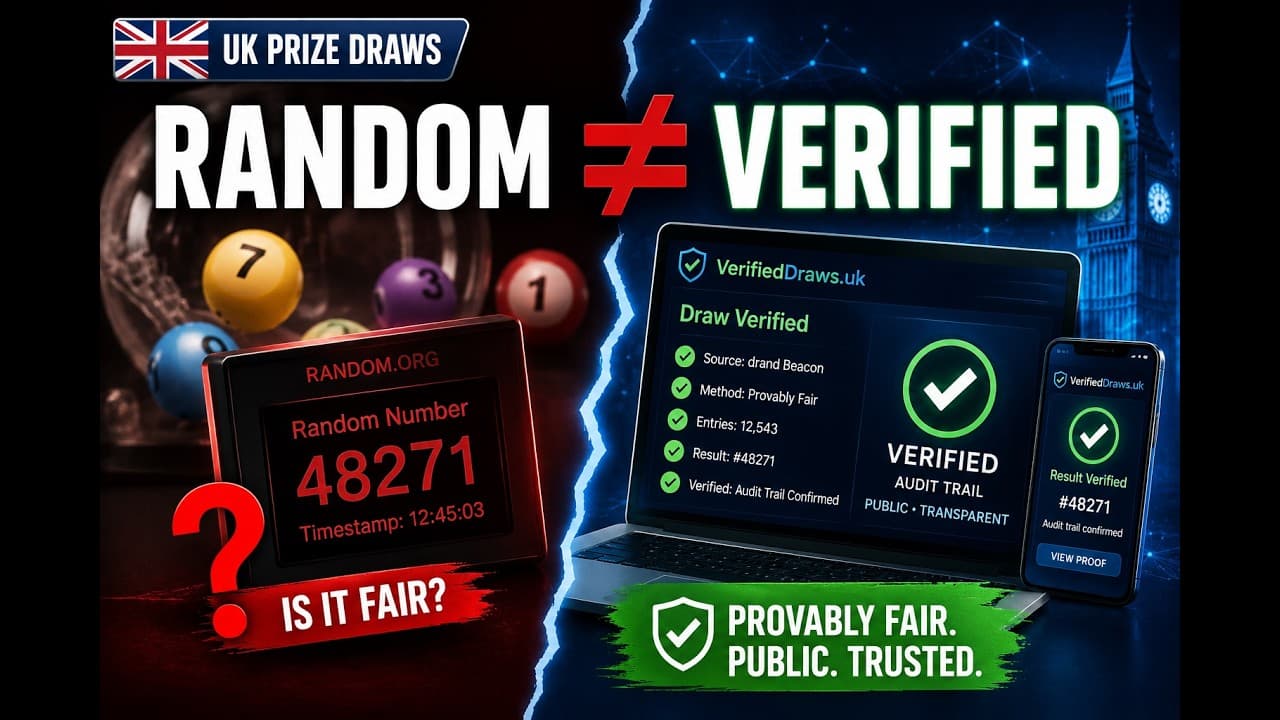
UK prize draws and online competitions are entering a new phase. The conversation is no longer only about whether a winner was picked at random. It is about whether the draw can be checked afterwards — whether the process was clear, auditable, and something an entrant can confirm for themselves.
We made a short video explaining exactly that: what is changing, why “random” is not the same as “verifiable,” and where drand and Verified Draws fit in.
This post covers the same ground in writing: what is changing in the UK prize-draw industry, why a random number is not automatically a verifiable one, what distributed randomness means, how drand works, and how Verified Draws fits into the bigger picture.
The UK prize-draw industry is growing
Prize draws and online competitions have become a major UK market. In response, the Department for Culture, Media and Sport (DCMS) published a Voluntary Code of Good Practice for Prize Draw Operators. It covers prize draws and competitions in Great Britain where the outcome is determined by chance and where players can choose between a paid entry route and a free one. By the DCMS's own figures, the sector is worth roughly £1.3 billion a year, with 7.4 million adult participants and more than 400 operators.
That scale is why standards matter. The point is not that every operator is doing something wrong. It is that when an industry grows quickly — especially one where people pay for the chance to win — the public needs confidence that players are protected and that draws are run fairly.
What the DCMS Code focuses on
The Code is built around three ideas: player protection, transparency, and accountability. In plain terms, operators are encouraged to protect players, make the rules clear, keep the free entry route visible, and explain the draw mechanism properly.
It also says prizes should be awarded fairly, in line with the rules shown to players — and that this may involve an independent person, independent supervision, a certified physical drawing machine, or a computer process that produces verifiably random and auditable results. That last phrase is the important one. It moves the conversation past simply picking a random number, and asks whether the process can actually be checked.
Random is not always verifiable
A random number can be unpredictable and still leave the bigger questions unanswered:
- Who controlled the generator?
- When was the number actually generated?
- Could it have been run more than once, until the result suited the operator?
- How was the number applied to the entry list?
- Can someone outside the company check the result later?
None of that implies dishonesty. It simply means the result still rests on trust. A verifiable draw works differently: it leaves a trail. The source of randomness can be checked, the method can be explained, and the result can be reproduced — so a stranger can confirm that the same process leads to the same winner. Random tells you the result was unpredictable. Verifiable shows you it was produced correctly.
What is distributed randomness?
Distributed randomness is a way of producing public randomness without relying on one person, one company, or one private system. Instead of a single operator generating the value, a network of independent participants produces it together. Because no single party controls the output, an operator can point to a randomness source that existed outside their own system — and outside their own control.
What is drand?
drand is a distributed randomness beacon — think of it as a public clock for randomness. At regular intervals it publishes a new round, each with a public random value that anyone can check afterwards. The network behind it is the League of Entropy, a coalition of independent organisations that provide public, verifiable randomness as a shared resource. The crucial property for a prize draw: a future drand round can be chosen before its random value exists. Nobody can know the result in advance, and once the round publishes, that public value can be used to calculate the draw.
How Verified Draws fits in
Verified Draws is built around this idea. It is designed for raffles, giveaways, and prize draws where the result should be checkable. It does not ask anyone to trust a private random number generator — it uses drand as the public randomness source. The process is straightforward:
- The entries are locked in.
- A future drand round is chosen.
- That drand round is published publicly.
- Verified Draws uses the public random value to calculate the winner.
- A verification code is produced so the result can be checked afterwards.
Instead of “trust us, we picked a random winner,” the operator can show the entries, the public randomness round, the method, and exactly how the result can be verified. That is the real value of a verifiable draw.
Why this matters for operators
For competition companies, this is a chance to raise standards now rather than react later. A verifiable process shows you take transparency seriously, and it helps build confidence with entrants — particularly when prizes are valuable and the audience wants reassurance the draw was handled fairly. It does not replace your other duties: you still need to follow the law, publish clear rules, provide a genuine free entry route where required, protect players, handle disputes, and manage data properly. But verifiable randomness solves one important part cleanly: showing how the winner was selected.
Why this matters for players
For players, the goal is simple. You should not have to rely on a livestream, a screenshot, or a company's word that the draw was fair. A stronger process gives you something to check: where the randomness came from, whether it was chosen before anyone knew the result, how it was applied, and whether the same result can be reproduced. Those are exactly the questions a transparent draw should be able to answer.
The future standard: clear, auditable, verifiable
The future of prize draws should not rest on asking people to trust what they see on screen. It should rest on giving them a process they can understand, a result they can check, and evidence they can rely on. That is how operators build confidence, how players get real transparency, and how the industry raises its standards.
To see it explained visually, watch the full video. To try a verifiable draw or check an existing result, run a draw on Verified Draws or verify a draw you already have in hand.
Sources and further reading
DCMS Voluntary Code of Good Practice for Prize Draw Operators
This article is for educational purposes only and is not legal advice. Prize-draw operators should review the official DCMS guidance and seek professional advice where needed.