Raffle Website vs WordPress: The True Cost of a WooCommerce Competition Site
Verified Draws · 4 July 2026
So you have decided to run competitions or prize draws online, and the advice you keep hearing is always the same: spin up WordPress, add WooCommerce, bolt on a raffle plugin, and you are away. It is the default for good reasons — WordPress is familiar, endlessly flexible, and cheap to start. But "cheap to start" and "cheap to run" are not the same thing. The WordPress raffle stack quietly hands you a second job you may not have signed up for: hosting, security, updates, plugin conflicts, performance tuning — and, the part that matters most for a prize draw, no way for your entrants to independently check that a draw was actually fair. This is an honest look at those trade-offs, and at the hosted alternative we built: RaffleForge.
The standard UK raffle stack: WordPress + WooCommerce + a competitions plugin
Almost every self-built UK competition website is the same three layers. WordPress is the content-management system underneath. WooCommerce turns it into a shop that can take card payments. And because WooCommerce has no concept of a raffle, a third-party plugin — Ultimate Raffle, Raffle for WooCommerce, Competitions for WooCommerce, or a giveaway tool such as RafflePress — adds the tickets, the numbered entries, the countdown and the winner draw on top.
It is a genuinely capable combination, and we will not pretend otherwise. You own everything, you can theme it however you like, and there is a plugin for nearly any feature you can name. If you already run a healthy WooCommerce store with a team that knows WordPress, nothing below is a reason to tear it down. But if you are starting from scratch, it is worth counting what the stack actually asks of you before you commit to it.
What the WordPress raffle stack really costs you
The plugin licence fees are the small part. The real bill is paid in hosting, upkeep and risk.
Hosting, updates and the plugin treadmill
You are now, whether you wanted to be or not, a systems administrator. Someone has to stand up the hosting, keep WordPress, WooCommerce, the theme and every plugin patched, take backups, and untangle the conflicts that appear when one plugin's update breaks another. Managed WordPress hosting takes some of this off your plate — WP Engine starts around $25 a month, Kinsta around $35 — but budget intro plans commonly renew 200-400% higher and cap the number of monthly visits you are allowed. That visit cap is exactly the wrong constraint for a business whose traffic spikes hard the moment a competition closes.
Performance, and why slow pages cost you sales
WordPress speed is fixable — but fixing it is an ongoing job, not a one-off. By default WordPress loads every active plugin on every request, and a typical WooCommerce store runs fifteen to twenty or more; WooCommerce's cart-fragments AJAX call, which fires on every page, is a widely documented example of the drag. The engineering DebugBear documents is real and effective — full-page caching cutting server response time from about 1.6 seconds to 104 milliseconds, object caching cutting database queries by around 86% — but that is work you or someone you pay has to do, and keep doing. And speed is not cosmetic: Google's own data found 53% of mobile visits are abandoned when a page takes longer than three seconds to load. On a raffle site, a slow page is simply an entrant who leaves before buying a ticket. To be fair, we do not claim WordPress is bad for SEO — a well-built, well-cached WordPress site can rank perfectly well. The point is only that the performance is yours to build and maintain.
Security and the payment surface
The moment you take card payments, you own a security surface. Every plugin is code running on your site, and every out-of-date plugin is a potential way in. Keeping the stack patched, hardened and PCI-conscious is your responsibility — or your host's, if you pay for it. A breach on a site that has taken people's money and card details is not a small problem, and it is a class of problem the WordPress stack asks you to carry yourself.
The one thing a plugin cannot add: independent fairness
Here is the gap that matters most, and no amount of WordPress configuration closes it. When a WooCommerce raffle plugin picks your winner, it picks it inside your own database, on your own server, with a random-number generator you control. You might be scrupulously honest — but your entrants have no way to know that. All they have is your word and, at best, a screen recording, which is trivially re-shot until the right name appears. "How do we know it isn't rigged?" is the single most corrosive question in this industry, and the standard WordPress stack has no real answer to it.
This is not a hypothetical concern in the UK. The DCMS Voluntary Code of Good Practice for Prize Draw Operators now expects draws to be run transparently and their results to be checkable by someone other than the operator — and the sector it covers is worth roughly £1.3 billion a year across 7.4 million participants and more than 400 operators. We covered what that shift means in UK Prize Draws Are Changing: Why Verifiable Randomness Matters.
The hosted alternative: RaffleForge
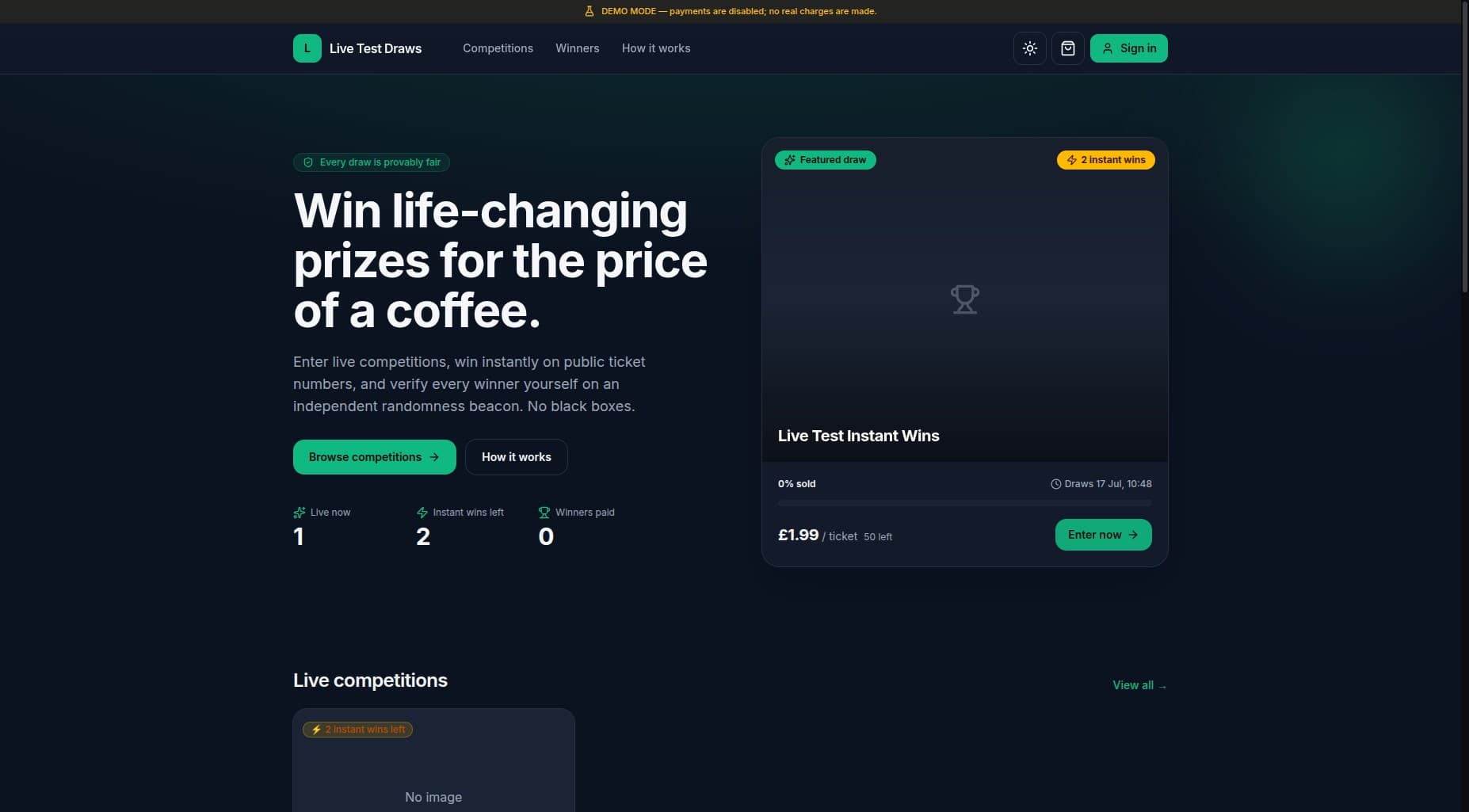
RaffleForge is the other path. Instead of assembling a raffle business out of WordPress parts, you sign up and get one, hosted for you. It is a purpose-built, multi-tenant platform — think "Shopify for prize draws" — where the storefront, the operator dashboard, the payments and the provably-fair draws are all first-class parts of the product rather than plugins you stitch together and maintain.
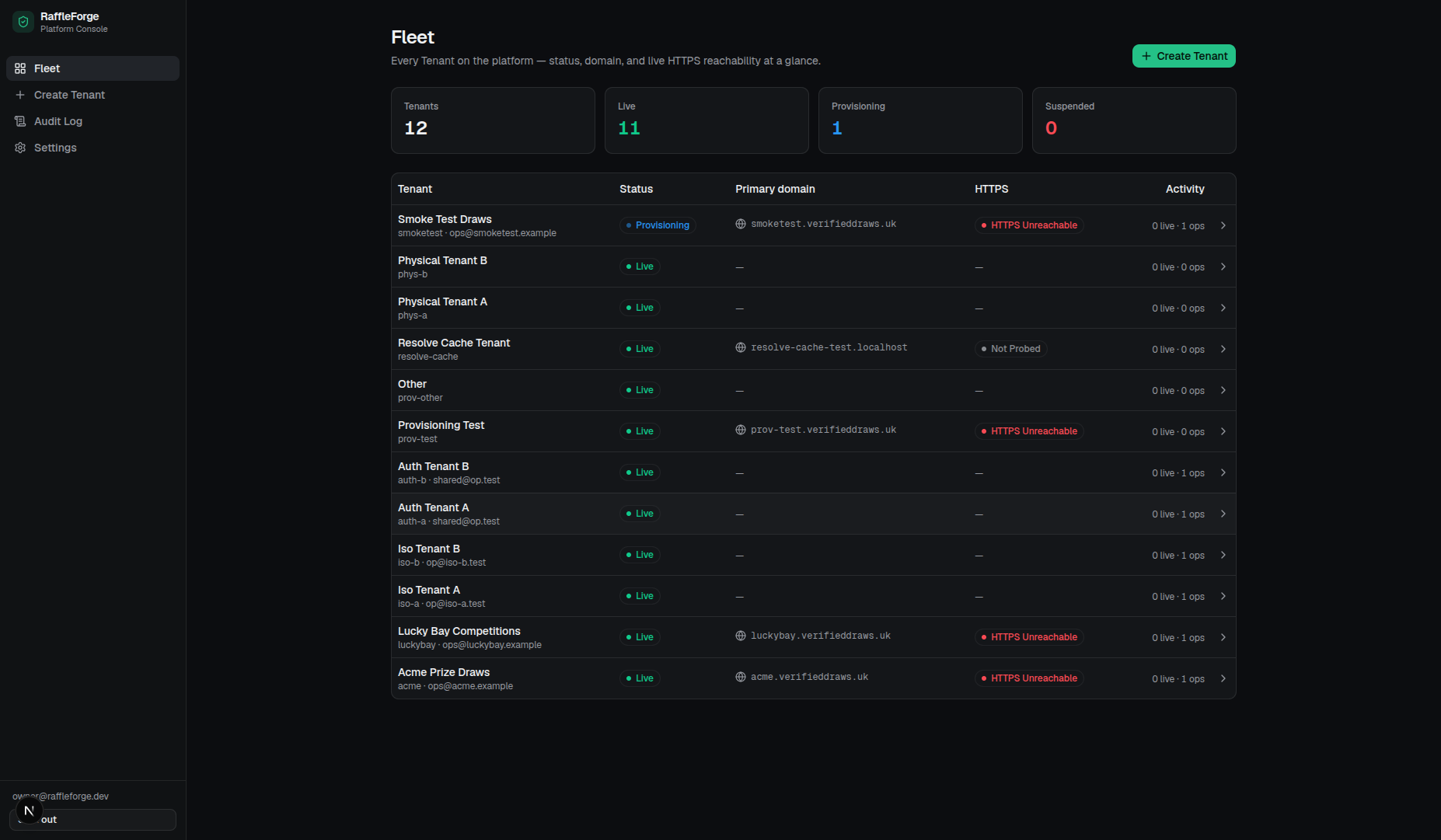
- Sign up and your branded storefront goes live immediately on your own secure subdomain (yourname.verifieddraws.uk) with HTTPS included. When you're ready, you can graduate to your own custom domain, with the SSL certificate handled for you by the platform team.
- A raffle-specific operator dashboard: Competitions, Instant Wins, provably-fair Draws, Customers, Store Credits, Orders, Payments, Branding, Media and Team — every one a first-class object, not a bolt-on plugin.
- Instant-win competitions with ticket numbers allocated the moment a customer buys, on a themed, fast, search-friendly storefront out of the box.
- Stripe-powered checkout and subscription billing, so taking payments is set up for you rather than assembled from a payment plugin and its add-ons.
- True database-per-tenant isolation: each operator's app is wired to exactly one database, so there is no shared row store for a forgotten filter to leak across.

Provably-fair draws: the part WordPress cannot give you
This is the reason Verified Draws exists, and it is built into every RaffleForge draw. Before a draw runs, it is committed to a specific future round of drand — a public randomness beacon produced by the League of Entropy, an independent coalition that includes Cloudflare and several universities. Because that random value does not yet exist when the draw is committed, nobody — not you, not us — can know or steer the winner in advance. Once the round publishes, the winner is a deterministic function of the committed entries and that public randomness.
The result is something a WordPress plugin structurally cannot offer. Every win — main-draw and instant alike — links out to an independent Verified Draws verification page that anyone can check. Run it honest and it goes green. Tamper with the inputs and it goes red. Your entrants stop having to trust you and start being able to check you, which is the cleanest possible answer to "is this rigged?"
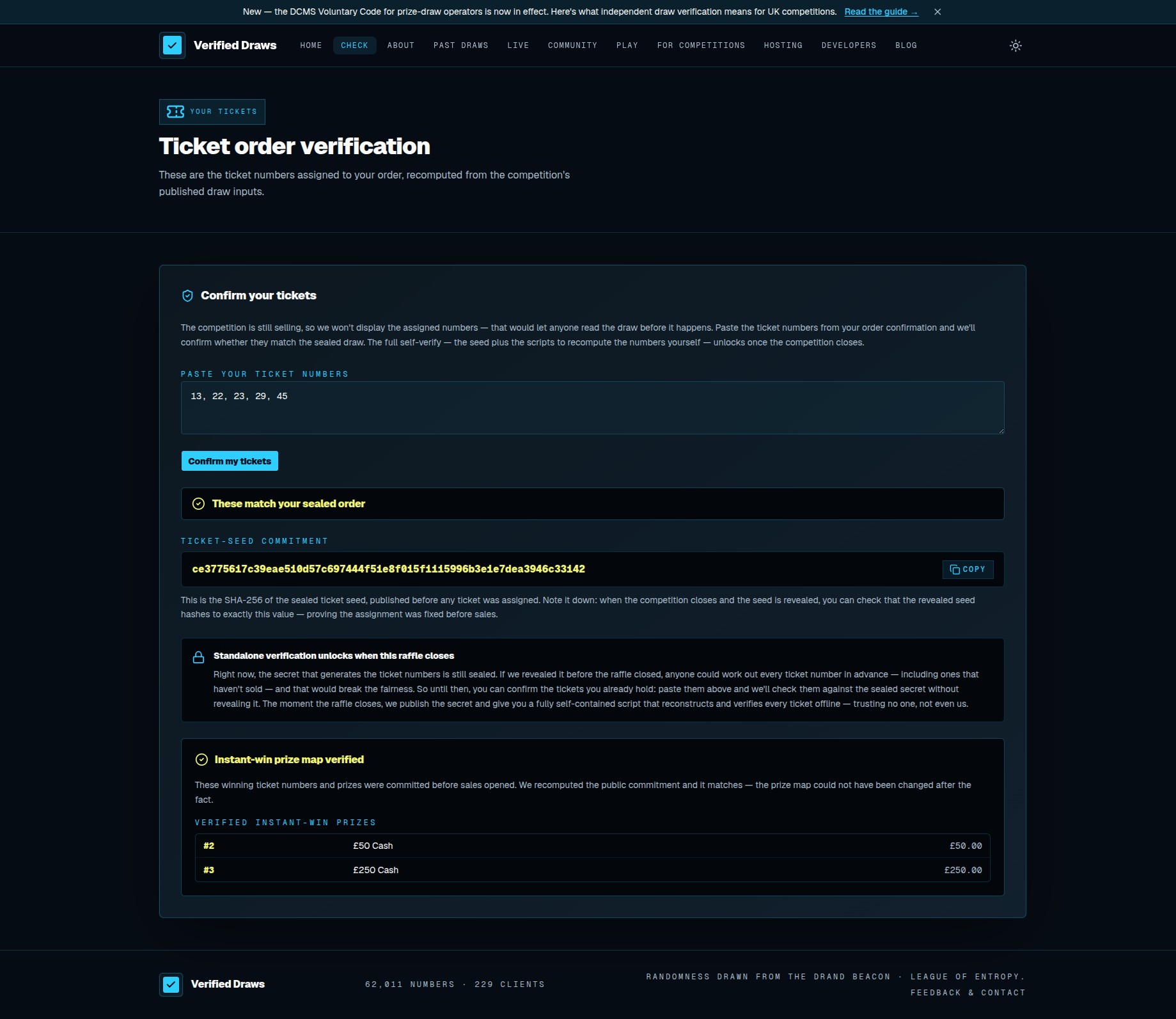
And because that fairness is a shared, free layer, it is not something you are locked into. If you ever leave RaffleForge, the verification links stay valid. It is the one item on this page that is genuinely free on both paths — you can add the very same provable fairness to an existing WordPress store with our free plugin, which we come back to below.
Fully managed hosting versus running your own stack
With RaffleForge there are no servers to stand up, no WordPress to patch, and no plugin treadmill. We run the platform — the fleet of hosted storefronts, the databases, the certificates, the scaling — so that you can run competitions. That matters most at exactly the moment a self-hosted WordPress site is most fragile: when a competition closes and everyone piles in at once. Managed hosting absorbs that surge, whereas an entry-level WordPress plan that caps monthly visits can hit you with overage charges or throttling right when the sale is happening.
Side by side: RaffleForge vs the WordPress raffle stack
A fair, like-for-like summary. Note that fairness itself is not really a contest here — it is free on both paths — so the real differences are hosting, performance and the dashboard. There is a fuller, visual version of this comparison on our hosting page.
- Setup and go-live — RaffleForge: sign up and your storefront is live on HTTPS in minutes. WordPress: stand up hosting, install and configure WordPress, WooCommerce, a theme and a raffle plugin, then wire up payments and SSL — days to weeks.
- Custom domain + HTTPS — RaffleForge: a secure subdomain with HTTPS at sign-up; graduate to a custom domain with SSL handled for you. WordPress: available, but domain and certificate setup is on you or your host.
- Storefront performance — RaffleForge: fast and search-friendly by default, with nothing to tune. WordPress: fixable with caching and CDN work, but an ongoing tax on your time.
- Raffle-specific dashboard — RaffleForge: built in, with Competitions, Instant Wins, Draws, Customers and Payments as first-class objects. WordPress: a general e-commerce admin with raffle features bolted on by separate plugins.
- Hosting, security & updates — RaffleForge: fully managed — no servers, no patch treadmill. WordPress: you stand up, secure and patch the stack yourself, or pay a managed host $25-35+ a month that often renews far higher.
- Traffic-spike handling — RaffleForge: managed hosting absorbs the competition-close surge. WordPress: entry plans cap monthly visits, so a spike can trigger overage charges or throttling.
- Provably-fair draws + verify links — RaffleForge: built in, drand-committed, every win independently checkable. WordPress: same fairness, free — add the Verified Draws WordPress plugin.
- Total cost of ownership — RaffleForge: one subscription, with the platform absorbing hosting, security and performance. WordPress: the licence fees look cheap, but hosting, maintenance, performance work and your own time are the real bill.
Who each option is really for
We would rather point you to the right tool than win the wrong customer, so here is the honest split.
Stay on WordPress if you already run an established WooCommerce store, with SEO, content, customers and a WordPress-literate team behind it. Replatforming an established store carries real, documented risk: poorly-executed ecommerce migrations commonly lose 20-60% of organic traffic in the first 90 days, and recovery takes months. If that is you, do not tear anything down — just add the free Verified Draws WordPress plugin: push a finished competition in one button, draw the winner live, and give everyone an independent verify link. You keep your stack and gain the one thing it was missing.
Choose RaffleForge if you are new or greenfield — you want to launch a competition business without becoming a part-time systems administrator first. You get the hosted storefront, the raffle-specific dashboard and provable fairness on day one, and you spend your time running competitions instead of maintaining WordPress.
See it for yourself
The fastest way to judge the difference is to look at both. Read the full RaffleForge hosting pitch and comparison, watch a live competition and draw in action, or verify a real draw yourself — pull the same public random value, re-run the maths, and watch it land on the same winner. When you are ready to start, create your hosted storefront and your branded, provably-fair raffle site goes live on a secure subdomain in minutes.
One honest note, because we are a verification company and will not oversell. Provable fairness is a precise, narrow guarantee: that the published winner is the deterministic result of a public random value committed before the draw. It does not vet who entered, and it is not a substitute for following UK competition rules, publishing clear terms, or offering a genuine free entry route where one is required. What it does do is settle the one question a WordPress raffle plugin never can — whether the draw itself was straight — and hand your entrants the means to check for themselves.