Instant Win Competitions Explained: How They Work, Are They Legal in the UK, and How to Prove They're Fair
Verified Draws · 4 July 2026
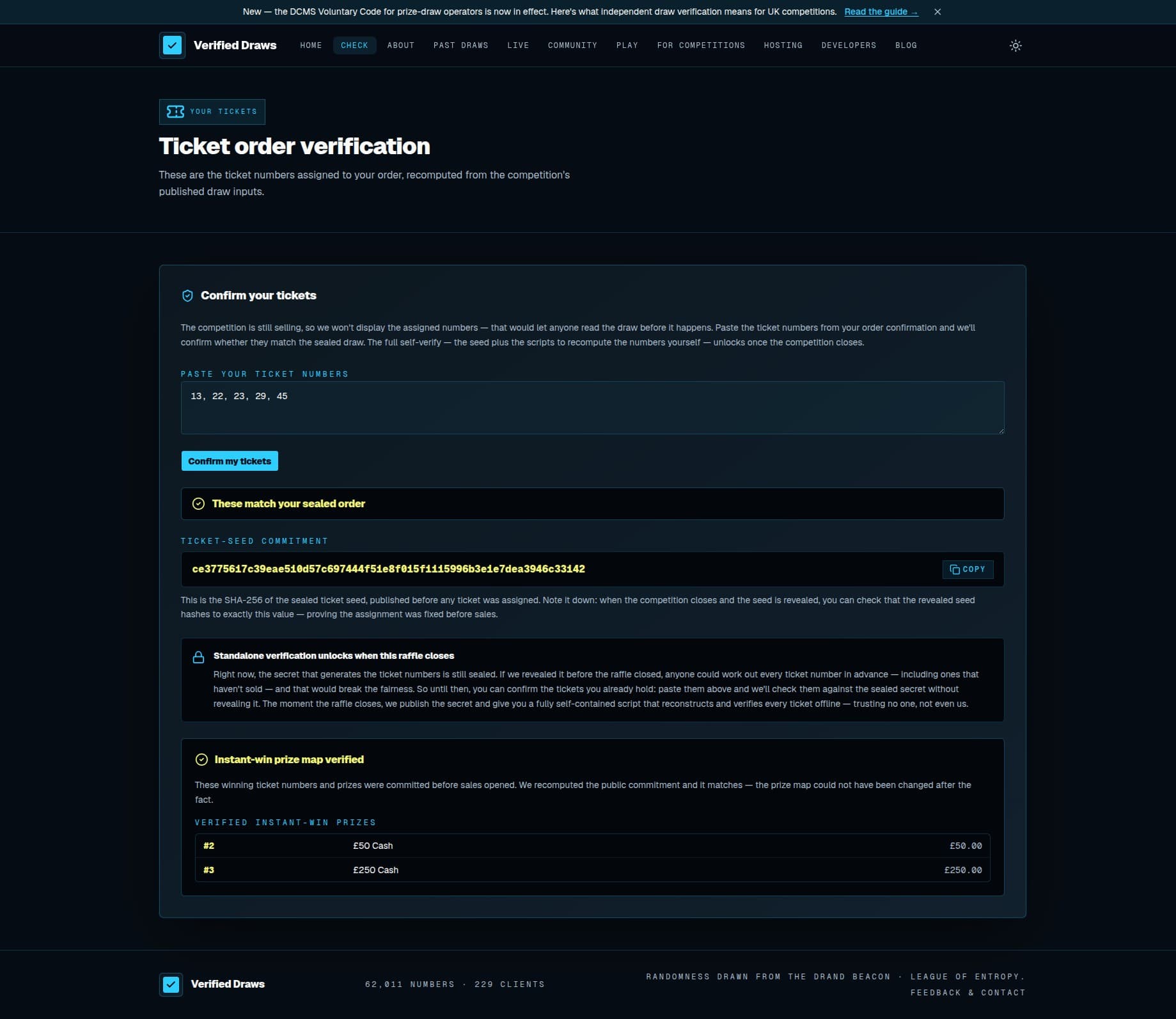
Instant win competitions are the most fun mechanic in the business, and the one most exposed to the word every operator dreads: rigged. The reason is structural. In an instant win, the winning ticket numbers are decided before a single ticket is sold — they sit on the operator's own server, waiting. An honest operator never touches them. But a buyer has no way to know that. This is a plain-English explainer of how instant wins actually work, whether they are legal in the UK, and the one narrow, provable fix that lets a buyer check the allocation was fixed in advance and never steered.
What is an instant win competition?
A normal prize draw picks one winner at the end, after entries close. An instant win is different: the prizes are attached to specific ticket numbers in advance, and you find out the moment you buy. Purchase ticket 4,417, and if 4,417 was a designated winning number, you win on the spot — a cash prize, a product, or site credit — usually alongside a bigger end-of-competition main draw.
Mechanically there are two common flavours. Either the winning ticket numbers are predetermined and stored before sale (the classic model), or a random-number generator decides win-or-lose at the point of purchase. Both share the same trust problem, and it is worth stating clearly.
The trust problem, stated plainly
Whichever flavour is used, the winning outcomes are determined by the operator, on the operator's infrastructure, with a generator the operator controls. Consider what a buyer can actually see:
- They cannot see the list of winning ticket numbers before they buy — and they should not be able to, or the competition would be trivially gamed.
- They therefore cannot know the list was not quietly edited: a winning number moved off a ticket that just sold, or a big prize shifted to a ticket a friend of the operator will buy.
- A screen recording proves nothing — it can be re-shot until it shows the right thing.
- "Our system allocated it fairly" is exactly the sentence a rigged system would also say.
None of this implies the operator is dishonest. It means an honest operator has no way to prove it — and that is a bad position to be in when people have paid you and the replies are filling with accusations. It is the same gap we traced through the Triple Six Fix and the Eddie Tipton case: a draw you cannot independently verify is just trust, and trust breaks.
Are instant win competitions legal in the UK?
This is the question that matters most, and the honest line is narrower than the marketing suggests. Under the Gambling Act 2005, a promotion that combines a predetermined prize, a payment to enter, and a result decided by pure chance is a lottery — and running a lottery without a licence is illegal. An instant win, where the outcome is chance at the point of purchase, sits squarely in the frame of that risk.
There are two well-established routes out of it, and a genuine competition uses one of them:
- A genuine free entry route — a way to enter for free (typically by post) that is promoted as prominently as the paid one, and gives the free entrant the same chance of winning. This makes it a "free draw" outside the licensing requirement.
- A real skill test — a question or task with enough difficulty that it genuinely limits who can enter, so the result is not down to pure chance. A trivially easy question does not count.
Without one of those, a paid instant win is, in practice, an unlicensed lottery. There is also a specific instant-win payment rule worth knowing: the DCMS Voluntary Code recommends that operators not accept credit-card payments in excess of £250 per month per player, and accept no credit-card payments whatsoever for instant win prize draws. (This is guidance about payment methods and player protection — it is separate from the licensing question above.)
This is a summary for orientation, not legal advice — instant win rules are genuinely fiddly and the penalties for getting the licensing wrong are real. Check the Gambling Commission's guidance on free draws and prize competitions and take professional advice before you run one.
How to prove an instant win is actually fair
Legality is one axis; provable fairness is another, and it is the one that answers "is it rigged?". The fix is narrow and specific: instead of storing the winning ticket numbers as a private list you ask people to trust, bind them to a source of randomness you do not control and cannot predict — before a single ticket sells.
In practice that is a commit-then-reveal scheme on a public randomness beacon:
- Before sale, commit: publish a cryptographic commitment that fixes the winning-ticket allocation to a specific future round of drand — a public randomness beacon whose value does not yet exist. You are locking in "the winners are whatever this future public coin-flip decides," without yet knowing the answer.
- The round publishes: at its scheduled time, drand emits a public random value that nobody in the competition produced or controlled.
- Reveal: the winning ticket numbers are derived deterministically from that public value and the committed inputs. Anyone can recompute them and confirm they match the commitment made before sale.
The property this buys you is exactly the one the trust problem was missing: because the randomness did not exist when the allocation was committed, the operator could not have known which tickets would win, and could not have moved a prize onto or off any ticket after sales began. A buyer does not have to trust that — they can check it.
How RaffleForge does it
This is built into RaffleForge's instant wins. The winning ticket numbers are committed to a future drand round before the competition opens, then revealed from the public value — the committed-then-revealed allocation described above. Instant Wins are a first-class object in the operator dashboard, not a bolt-on, and every instant win links out to an independent Verified Draws verification page. Run it honest and it goes green. Tamper with the inputs and it goes red.

If you already run a competition site, you do not have to move to get this — the verifiable-draw layer is free and portable via the Verified Draws plugin and API. If you are starting fresh and want it built in from day one, the hosting page walks through the whole platform, or you can create a provably-fair storefront in minutes.
See a real one
The point of all this is that you should not have to take our word for it either. Verify a real draw yourself, watch a live competition, and read the companion guide How to Run a Provably-Fair Giveaway for the operator's-eye view.
One honest limit, because we are a verification company and will not oversell. A verified instant win proves a narrow, precise thing: that the winning ticket-number allocation was fixed in advance to a public random value and was not steered afterwards. It does not vet who entered, it does not police your terms, and it is not a substitute for a genuine free entry route or a real skill test where the law requires one. What it does settle — completely — is the question a private winning-numbers list never can: that the allocation was straight, and anyone can check.